

Will AI Overviews Change How Google Ads Work?
Written by Lauren Parker, CEO & Senior Supervising Account Director
Lauren helps businesses navigate paid search and the changing digital landscape with practical, performance-focused marketing.
Updated: 08/19/2026
Google Ads are not going away because of AI Overviews, but the way ads appear in Google Search is changing. Google is already placing ads inside AI-powered search experiences, which means advertisers should focus less on protecting the old search-results page and more on making campaigns, ads, and landing pages useful enough to succeed in the new one.
Key Takeaways
- Google Ads are not disappearing because of AI Overviews.
- The bigger change is where ads appear, not whether they exist.
- AI Overviews are strong for quick informational questions.
- Searches can still connect customers with businesses when they are ready to buy, book, call, or hire.
- Google says existing SEO fundamentals still matter in AI search.
- Better targeting, negative keywords, ad assets, and landing pages matter more as Search becomes more AI-driven.
Table of Contents
- Will Google Ads disappear because of AI Overviews?
- Where will ads appear as Google Search becomes more conversational?
- Do AI Overviews replace customers who are ready to buy?
- Do paid ads determine what appears in AI Overviews?
- Is Google moving toward a chat-first search experience?
- What should advertisers do about AI Overviews?
- Why do landing pages matter even more now?
- What does the future of Google Ads look like?
- Frequently Asked Questions
Will Google Ads disappear because of AI Overviews?
No, Google Ads won’t disappear because of AI Overviews. Google has already built advertising into AI Overviews and has expanded those ad experiences across Search. Google has also said that ads can appear in AI Mode when they are relevant to the user’s query and the AI-generated response.
The important distinction is between ads disappearing and the search-results page changing. I don’t see Google abandoning ads just because Search is becoming more conversational. I expect the format to change, but not the business model behind it.
My bigger concern for advertisers is not, “Will Google stop showing my ads?” The better question is, “Will my ads and landing pages still make sense when Google changes how people discover and evaluate businesses?”
That is where the real work is.
Where will ads appear as Google Search becomes more conversational?
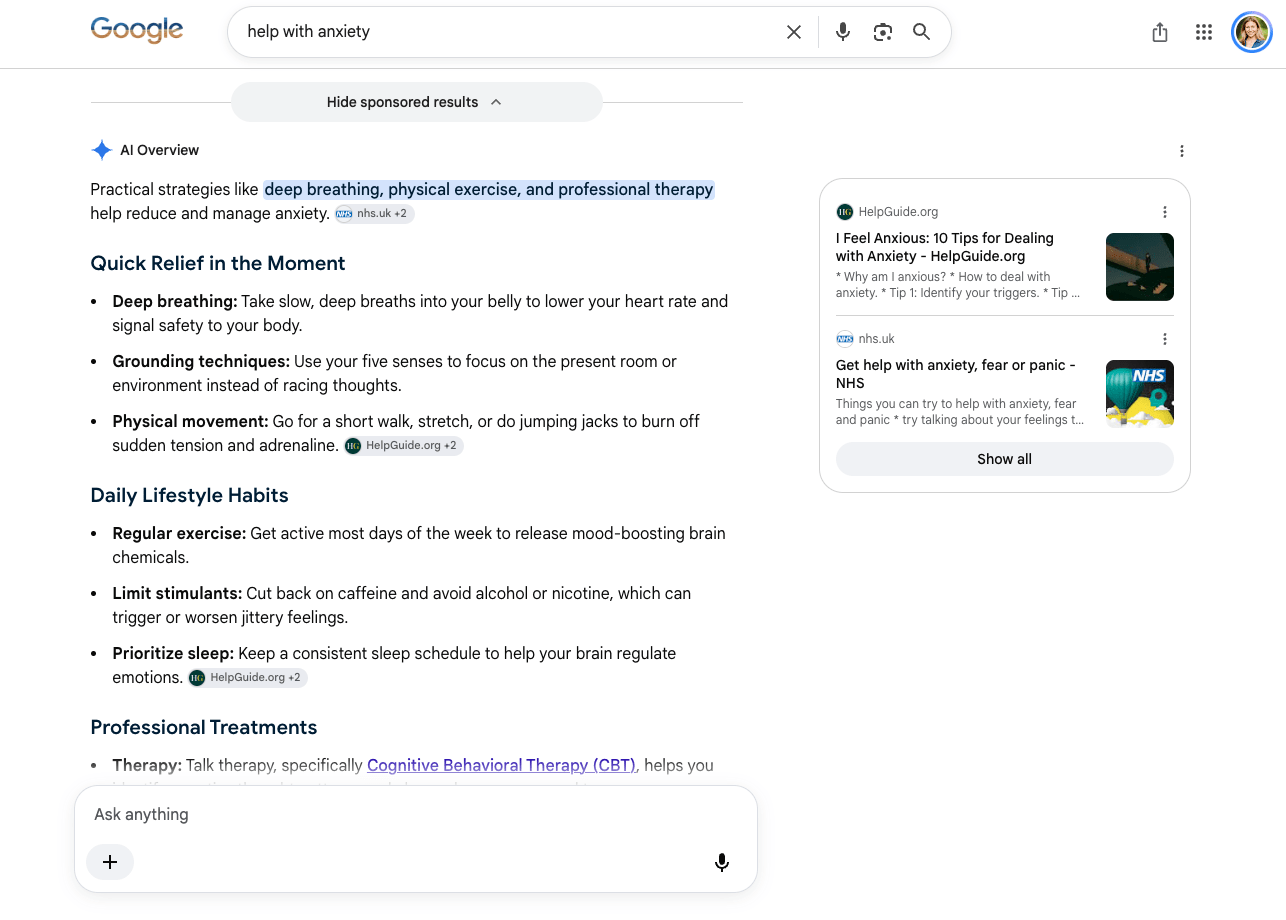
Ads are increasingly being integrated into AI-powered Search experiences rather than living only above or below a traditional list of links. Google has publicly described ads appearing within AI Overviews and has also announced testing of ads in AI Mode.
That shift makes sense from Google’s perspective. If Search becomes a place where someone asks a question, gets an answer, asks a follow-up, and eventually decides what to do, advertising has to move with the journey.
Think about the difference between these two experiences.
Someone searches, “What should I look for in a new website for my small business?” That person may be gathering information. Someone searches, “small business website designer near me,” and the intent is very different. The second person may be ready to contact a business.
The interface can change dramatically while that underlying need stays remarkably familiar.
Do AI Overviews replace customers who are ready to buy?
AI Overviews can answer many informational questions, but an answer does not replace the business a customer ultimately needs. Google itself describes AI Overviews as a way to help people understand complicated topics quickly and then explore supporting links and websites.
Consider a simple example: “Why is my dog limping?” An AI answer can explain possible reasons and tell someone when veterinary care may be appropriate. The answer can be useful without being the final destination.
The commercial journey is different when the search becomes “veterinarian near me,” “emergency vet open now,” or “best orthopedic vet for dogs.” At that point, the customer needs a real practice, a real location, real availability, and a way to take action.
That distinction matters for advertisers.
Some informational searches may be increasingly satisfied inside Google’s interface. Commercial searches still create opportunities for businesses to win the next step.
Do paid ads determine what appears in AI Overviews?
Google’s published guidance does not say that buying ads gives a website preferential treatment in organic AI features. Google says AI Overviews and AI Mode use its existing Search systems to identify relevant supporting links, and Google says there are no special requirements or paid placements needed to become eligible for those organic AI features.
Paid advertising and organic visibility are separate systems. An advertiser can buy a Google ad without automatically earning an organic citation in an AI-generated response.
Google also clearly labels paid placements as advertising. Google has described ads appearing in AI Overviews as “Sponsored,” reinforcing the distinction between advertising and the organic sources used to support an AI response.
So I would not spend money on ads because you think the ads will somehow make Google more likely to cite your website organically. Spend money on ads because the campaign can produce profitable customers.
Is Google moving toward a chat-first search experience?
Yes, Google is moving toward a more conversational Search experience, and the direction is already visible in AI Overviews and AI Mode. Google says AI Mode is designed for more complex questions, follow-up questions, comparisons, and deeper exploration.
I think the long-term destination is fairly obvious.
I expect Google to keep reducing the friction between asking a question and getting something useful done. Instead of typing a query, scanning ten blue links, opening several pages, comparing the answers, and searching again, users may increasingly have a conversation with Search.
That sounds dramatic for marketers because it is dramatic.
But it is also a continuation of something Google has been doing for years. Featured snippets reduced the need to click for certain answers. AI Overviews take that idea much further. AI Mode adds conversation and follow-up questions to the experience.
What should advertisers do about AI Overviews?
Advertisers should focus on campaign quality, targeting, messaging, and conversion performance instead of trying to predict every change Google will make to the interface. Google’s own advertising guidance emphasizes AI-powered matching, bidding, responsive ads, negative keywords, and other controls that help advertisers steer campaigns.
If you’re building or revisiting a Google Ads campaign, start with the basics. Use negative keywords aggressively enough to keep irrelevant searches out. Review search terms instead of assuming the campaign understands your business perfectly. Give Google strong creative assets and clear information about what you actually sell.
Google’s current advertising products increasingly use AI to match ads to searches and adjust campaigns. That makes the quality of the signals you provide more important, not less.
The goal is not to outsmart Google’s AI. The goal is to give it better information.
Why do landing pages matter even more now?
Landing pages matter because a great ad still needs a useful destination that turns interest into action. Google also emphasizes useful and relevant experiences across its Search guidance.
This is the part advertisers sometimes overlook.
If your ad promises “same-day plumbing service” but the landing page opens with a generic company biography, you have a problem. If the ad promises a consultation but the visitor cannot figure out how to book one, you have a problem.
AI may change how someone discovers your business. It does not remove the need for a website that convinces that person to take the next step.
That is why my advice is simple: make every landing page somewhere you would be proud to send a customer. That has been good marketing advice for years. It still is.
What does the future of Google Ads look like?
The future of Google Ads will likely be more integrated with AI-assisted discovery, but the fundamental job of advertising will remain the same: connect the right customer with the right business at the right moment. Google is already testing and expanding new ad formats designed for AI-powered Search, including conversational and AI-assisted experiences.
The format will change.
The auction will evolve. The interface will evolve. The way people phrase searches will evolve. Google is giving its systems more responsibility for matching users with relevant ads. But the fundamentals remain.
A customer has a problem. A business can solve it. An advertisement helps connect the two. That is why I am not panicking about AI Overviews. I am paying attention to them.
Frequently Asked Questions
Will AI Overviews eliminate Google Ads?
No, AI Overviews are not eliminating Google Ads. Google is actively integrating ads into AI-powered Search experiences, including AI Overviews and AI Mode.
Do Google Ads help a website appear in AI Overviews?
No, buying Google Ads does not automatically make a website eligible for organic AI Overview citations. Google treats paid advertising and organic Search visibility as separate systems.
Should businesses stop investing in SEO because of AI?
No, businesses should not stop investing in SEO because of AI Search. Google’s guidance indicates that foundational Search practices remain relevant to AI Overviews and AI Mode.
Should advertisers change their Google Ads campaigns because of AI Overviews?
Yes, advertisers should continue improving their Google Ads campaigns as AI-powered Search evolves. Campaign structure, targeting, creative, negative keywords, and landing pages still matter.
Are AI Overviews replacing traditional Google Search?
No, AI Overviews have not replaced traditional Google Search results. They add an AI-generated layer to the Search experience, while AI Mode provides a more conversational way to explore complex questions.
About LMR Digital Marketing
LMR Digital Marketing helps businesses navigate Google Ads, SEO, paid search, and the broader digital marketing landscape with practical strategy and clear communication. The practice focuses on connecting marketing decisions to real business outcomes, from better campaign targeting and landing pages to stronger conversion performance. For businesses trying to make sense of AI-powered Search without chasing every new headline, LMR Digital Marketing brings an experienced, measured perspective to the conversation.
LMR Digital Marketing
Digital Marketing Services for Mental & Behavioral Healthcare. Reach out today to see if we are a good fit.
Follow Us On Instagram!
Who We Help
- Applied Behavior Analysis Companies
- Group Therapy Practices
- Rehab Centers
- Telehealth Companies
- EHR and other Saas Companies
- Speech Therapy Practices
- Medical Practices
- Psychiatric & Medication Management
Helpful Page Links