
Mental health SEO, measured in intakes
Behavioral Health SEO Company
At LMR Digital Marketing, we are a Behavioral Health SEO Company helping therapy practices and mental health organizations improve search visibility and connect with the right audience. Our work focuses on ethical strategy, clear site structure, and content that reflects how care is actually delivered, so your practice shows up in search in a way that feels accurate, intentional, and aligned with your values.
LMR Digital Marketing is a behavioral health SEO company for treatment centers, group practices, multi-location clinics and mental health organizations. We help the right people find you on Google, in the map results and in AI search, and then make it easy for them to reach out.
We judge our work by calls, consults and intakes, not rankings alone.
Solo therapist or private practice? See SEO for therapists


Written by Lauren Parker, CEO and former private practice owner. Reviewed by Heather Scrima, SEO and AEO specialist with 15+ years of experience. Updated .

Practices we help grow

Quick Facts: Behavioral Health SEO Company
The short version, before the details.
Who this service is for
- Therapy practices
- Behavioral health clinics
- Mental health organizations
- Multi-location or growing practices
What this SEO focuses on
- Improving SEO visibility in Google search results
- Attracting qualified, high-intent website traffic
- Supporting long-term, sustainable growth
SEO strategies we use
- Keyword research specific to behavioral health
- On-page SEO and content optimization
- Technical SEO and site structure improvements
- Ongoing performance tracking and refinement
What makes behavioral health SEO different
- Industry-specific language and search behavior
- Ethical and compliant marketing considerations
- Emphasis on clarity, accuracy, and trust
Why behavioral health SEO is different
Mental health SEO plays by stricter rules than regular SEO.
Ranking a plumber and ranking a therapist are not the same job. Health content is held to a higher standard by Google, the people searching are often having a hard week, and the ethics of your profession shape what your marketing can say.
- 01
A higher bar for trust
Google’s quality guidelines treat health topics as “Your Money or Your Life” content, judged more strictly on experience, expertise, authority and trust (E-E-A-T). Generic content written by no one in particular struggles to rank here.
- 02
Searchers are often in a hard moment
Someone searching for an anxiety therapist at 11pm needs answers fast: who you help, whether you take their insurance, and how to book. Pages that answer those questions quickly are the pages that turn searches into consults.
- 03
Families search too
A parent looking for a teen IOP, a partner researching addiction treatment, an adult child finding psychiatry for a parent. Behavioral health content has to speak to the person seeking care and to the people helping them get there.
- 04
Ethics shape the strategy
No fear-based headlines, no promised outcomes, no review tactics your licensing board would frown on, and tracking set up with client privacy in mind. Visibility built on accuracy lasts longer than visibility built on shortcuts.
SEO Built for Behavioral Health, Not General Businesses
Behavioral health websites are not like other service-based businesses. The information people find, how it’s presented, and how easily it’s understood all matter.
Our SEO work is shaped by an understanding of how people search for mental and behavioral health services and what they need when they land on a page. We focus on clear structure, accurate language, and content that helps people understand what a practice offers before they ever make contact.
Rather than chasing volume or trends, we prioritize visibility for the services you actually provide and the audience you want to reach. That means building pages that search engines can understand and people can navigate without confusion.
The result is a search presence that feels steady, intentional, and aligned with the work your practice does every day.
Mental health keywords
How do you choose the right mental health keywords?
The best mental health keywords aren’t necessarily the phrases with the highest search volume. They are the searches that closely match your services, specialties, location, and the intent of the people you want to reach.
At LMR Digital Marketing, we look at how prospective clients actually search for care. That may include service searches such as “couples therapy,” specialty searches such as “EMDR therapist,” location searches such as “therapist near me,” and more specific combinations that signal someone is actively looking for a provider.
We then map those searches to the right pages so your website builds visibility without multiple pages competing for the same keywords.
Volume isn’t value
Two searches, compared. Illustrative, not real data.
“therapy”
“EMDR therapist in Denver”
A broad term brings visitors from everywhere looking for anything. A specific one brings fewer people who are much closer to choosing a provider like you.
The six kinds of mental health keywords we plan around. Pick one to see examples and where it belongs on your site.
Service searches
- “couples therapy”
- “teen IOP”
- “medication management”
- “anxiety therapy”
People searching for a type of care usually know what they want. Each service you want to grow deserves its own page that explains who it is for, what to expect, and how to start.
Condition searches
- “OCD treatment”
- “postpartum depression help”
- “trauma therapy”
- “eating disorder treatment”
Condition searches mix people looking for help with people looking for information. The page needs to educate first, then make the path to care obvious.
Specialty & modality searches
- “EMDR therapist”
- “DBT program”
- “perinatal therapist”
- “ketamine-assisted therapy”
Modality searches are some of the strongest signals in mental health SEO. Someone who types “EMDR therapist” has usually done their research and is ready to choose a provider.
Location searches
- “therapist near me”
- “psychiatrist in Austin”
- “Denver couples counselor”
- “IOP in Phoenix”
Most in-person care starts with a local search. These terms are won with location pages, a well-managed Google Business Profile and consistent listings, not with a city name dropped into every paragraph.
Insurance & payment searches
- “therapist that takes Aetna”
- “in-network psychiatrist”
- “sliding scale therapy”
- “does insurance cover IOP”
Payment questions show up right before someone books. Clear, accurate insurance information is one of the fastest ways to turn a visit into an inquiry, and it reduces calls from people you can’t serve.
Questions & research searches
- “what is EMDR”
- “signs of burnout”
- “how to find a therapist”
- “what happens in an IOP”
Informational searches build trust and topical authority. They rarely book on the first visit, so every article should point to the service it relates to, and should never compete with that service page for the same term.
One page, one primary intent.
When three pages all try to rank for “anxiety therapy,” Google has to guess which one matters, and often ranks none of them well. We build a keyword map so every important search has one clear home, and supporting pages link to it.
Everything search engines and AI tools look for
What our behavioral health SEO services include.
Our SEO services are built to support clarity, performance, and long-term visibility. Depending on your needs, this may include:
- Keyword research aligned with behavioral health services and search intent
- On-page optimization for service and location pages
- Website structure and internal linking improvements
- Technical SEO support to improve site performance and usability
- Ongoing review and refinement based on performance data
We focus on strategies that make sense for behavioral health practices, not generic tactics pulled from unrelated industries. Behavioral health SEO covers six areas that work together. Pick one to see what we do and why it matters for a mental health practice.
1 of 6
Show up in the map results for your city and service area.
For in-person care, the map pack is often the first thing people see and the first thing they click. We manage the signals that tell Google where you provide care and what you treat, so the right people nearby find you first.
Request a strategy callWhat’s included
- Google Business Profile managementCategories, services, photos, posts, Q&A and review responses kept accurate and active, for every location you have.
- Location and service-area pagesA page for each city or office, written for the people there rather than a list of towns pasted into the footer.
- Consistent listings everywhereYour name, address and phone match across Psychology Today, Healthgrades, insurance directories and the rest, which is a quiet but real local ranking factor.
- Telehealth and multi-state visibilityFor virtual practices, state-level pages and licensing information that help you appear where you are licensed to see clients.
- An ethical review strategyWays to grow reviews that respect your profession’s rules about soliciting testimonials from clients.
2 of 6
Pages and articles built around how people actually search for care.
This is where keyword research becomes something a visitor can read. We plan, write and optimize the pages that match each important search, in your voice, with a clear path to booking on every one.
Request a strategy callWhat’s included
- A keyword-to-page mapEvery priority search gets one clear home on your site, so pages support each other instead of competing.
- Service, specialty and condition pagesWritten for the person searching, answering who it’s for, what to expect, cost and next steps.
- Clinician bio pagesBios that mention specialties and modalities, which rank for searches like “EMDR therapist” and help people choose.
- Blog content from real client questionsArticles written by people, reviewed for accuracy, and linked to the service they relate to.
- Titles, headings and internal linksThe details that help Google understand each page and help visitors move to the next one.
3 of 6
A fast, clean site that search engines can read without guessing.
Great content won’t rank on a site Google can’t crawl, or one that loads slowly on a phone. We find and fix the technical problems that quietly hold rankings back.
Request a strategy callWhat’s included
- Speed and Core Web VitalsFaster pages on mobile, where most people search for care.
- Crawling and indexing fixesMaking sure the pages that matter are indexed, and the ones that don’t are kept out of the way.
- Schema markupStructured data for your practice, services, FAQs and authors, so search engines and AI tools understand who you are.
- Site structure and redirectsConsolidating duplicate or competing pages and redirecting them properly so their value isn’t lost.
- Mobile and accessibility basicsReadable, tappable, usable pages for everyone who lands on them.
4 of 6
Clear signals that real experts stand behind your content.
For mental health topics, Google wants to know who wrote a page and why they should be trusted. We make expertise visible on every important page, and build authority around the topics your practice wants to be known for.
Request a strategy callWhat’s included
- Named authors and credentialsBylines and author pages for your clinicians, with licenses and specialties, instead of anonymous content.
- A clinical review stepImportant pages reviewed by a clinician on your team before they go live, with the reviewer named on the page.
- Reputable sourcesCitations to organizations such as NIMH and SAMHSA where they support what a page says.
- Topic clustersSupporting articles around each core service, so your site becomes the obvious authority on what you treat.
- Reviews and reputationMonitoring and responding to reviews so your reputation matches the quality of your care.
5 of 6
Be the practice AI tools mention when people ask for help.
More people now ask Google’s AI Overviews, ChatGPT and other assistants where to find a therapist or what a treatment involves. Answer engine optimization (AEO) helps your practice be part of those answers.
Request a strategy callWhat’s included
- Question-led contentClear, direct answers to the questions people ask AI tools, written so they can be quoted accurately.
- Entity clarityMaking it unmistakable who you are, where you practice, who you treat and what you offer, everywhere your practice appears online.
- Structured data for AISchema that helps AI systems connect your services, clinicians and locations.
- AI visibility monitoringChecking how your practice shows up in AI answers and adjusting content where it doesn’t.
6 of 6
Know what SEO is producing in calls, consults and intakes.
Rankings are a means, not the goal. We set up tracking that follows organic visitors to the actions that matter, then report on it in plain language every month.
Request a strategy callWhat’s included
- Google Analytics and Search ConsoleSet up correctly, with the conversions that matter to a practice defined from day one.
- Call, form and booking trackingEvery call, form and booking click from organic search attributed, set up with client privacy in mind.
- Leads and intakes, not just trafficWhere your intake process allows, we connect organic visits to booked consults and intakes.
- A monthly report you can read in five minutesWhat moved, what it produced, and what we’re doing next.
Working with therapists in private practice? See our page on SEO for therapists.
Local SEO and Google Business Profile
How does local SEO help behavioral health practices get found?
Local SEO helps behavioral health practices appear when people search for care in a specific city, neighborhood or service area. For practices providing in-person care, that visibility matters most when someone searches for a therapist, psychiatrist or treatment program nearby.
LMR looks at the signals that help search engines understand where you provide care, including your location and service pages, site structure, local search terms and Google Business Profile. The goal is a consistent local presence that makes it easy for the right people in your area to find and understand your practice.
- Google Business Profile set up and managed for every location
- Location pages that connect your services to the communities you serve
- Matching details across Psychology Today, Healthgrades and insurance directories
- State-level visibility for telehealth practices
Riverbend Counseling Collective
4.9(86)· Psychotherapist
Open· Closes 7 PM· Online appointments
Fictional practice, shown for illustration.
Tap a number to see what it does for your rankings
Reviews
Rating, review count and how recently reviews arrived all affect local rankings and clicks. We build a review process that fits your profession’s ethics rules.
Primary category
Your main Google Business Profile category (for example “Psychotherapist” or “Mental health service”) is one of the strongest local ranking signals. Most practices pick it once and never revisit it.
Services and specialties
Listing services, specialties and attributes such as telehealth or insurance helps you appear for more specific searches, like “EMDR therapist near me.”
Website and booking links
The link from your profile should go to the most relevant page, not just your homepage. That page has to back up what the profile says.
Authority and E-E-A-T
How do you build search authority for mental health content?
Strong mental health SEO requires more than placing keywords on a page. Search engines and potential clients both need clear reasons to trust the information they find.
That means creating accurate, useful content that reflects the services your practice actually provides, while making expertise and authorship clear. LMR also looks at site structure, internal linking, relevant external sources and the content surrounding your most important service pages, so your website builds authority around the topics most relevant to your practice.
The trust signals we add to every important page. Hover over one to see it on the example.
- 1Named author with credentialsA real clinician’s name, license and specialties, linked to their bio page.
- 2Clinical reviewer and dateWho checked the page for accuracy, and when it was last updated.
- 3Citations to reputable sourcesLinks to organizations like NIMH or SAMHSA where they support a claim.
- 4A clear next stepA link to the matching service page, so information turns into care.
- 5Crisis informationA short note pointing to 988 on pages where someone might be struggling.
Anxiety · Article
What to expect in your first EMDR session
Written by Dr. Maya Ellis, PsyD
Licensed psychologist · EMDRIA-certified
Sources: National Institute of Mental Health; American Psychological Association
If you are in crisis, call or text 988 to reach the 988 Suicide & Crisis Lifeline.
Fictional example for illustration.
Results and reporting
How do you measure whether behavioral health SEO is working?
SEO success isn’t just about moving a keyword from one position to another. Rankings matter, but only when greater visibility brings the right people to your website and some of them become clients.
LMR monitors search visibility, organic traffic, keyword performance and how visitors interact with your most important pages, so we know what’s gaining traction and where opportunities remain. Every month, that turns into a short plan for what we’ll refine next.
- Visibility for the searches that match your services
- Organic traffic to service, specialty and location pages
- Calls, forms and booking clicks from organic search
- Booked consults and intakes, where your intake process allows
- How your practice appears in AI search answers
Matrescence Therapy
Leads from organic search, Jan–Mar vs. Apr–Jun
Glass Psychotherapy
Visits from organic search, Jan–Mar vs. Apr–Jun
Our process and timeline
How Behavioral Health SEO Works at LMR
Behavioral health SEO requires a different approach than general marketing. Search behavior, language, and trust all matter more, and mistakes can impact both visibility and credibility.
At LMR Digital Marketing, our SEO process is built specifically for therapy practices and behavioral health organizations. We focus on accuracy, clarity, and long-term performance, not shortcuts or volume-based tactics.
How long does behavioral health SEO take?
Most practices see early movement within 3 to 6 months and meaningful growth in organic leads within 6 to 12 months. Here is what typically happens along the way.
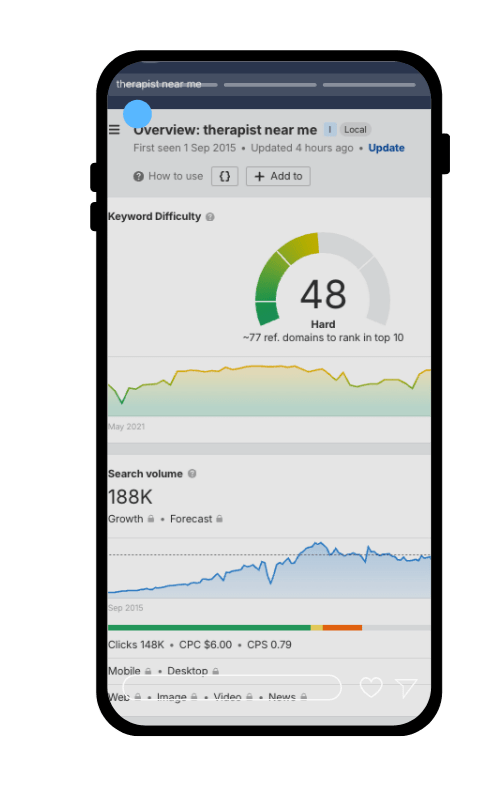
Every strategy starts with real search data, like the volume and difficulty behind “therapist near me.”
- Month 1
Research and audit
Step 1: Understand Your Practice and Audience
We start by learning how your practice works, who you serve, and how potential clients search for care. This includes your specialties, services, location, and the language your audience actually uses when looking for support.
What you’ll see: We audit your website, Google Business Profile, listings and competitors, and map the searches that match your services and locations.
- Months 2–3
Build the foundation
Step 2: Build a Clear SEO Foundation
We optimize your website structure, pages, and content so search engines can clearly understand what you offer. This includes keyword strategy, page optimization, internal linking, and technical improvements that support visibility and usability.
What you’ll see: Technical fixes, the keyword-to-page map, profile cleanup, and the first new or rewritten service and location pages.
- Months 3–6
Early movement
Step 3: Create Content That Serves a Purpose
SEO content should answer real questions and support informed decision-making. We help develop service pages and educational content that reflect your expertise while aligning with how people search for behavioral health services.
What you’ll see: More impressions, rankings for specific and local searches, and better map visibility. The first organic inquiries usually start to show up here.
- Months 6–12
Meaningful lead growth
Step 4: Monitor, Adjust, and Improve
SEO is ongoing. We track performance, evaluate what’s working, and make informed updates over time to support steady growth and changing search behavior.
What you’ll see: Content and authority compound. Competitive terms start moving, and organic search becomes a steady, measurable source of inquiries.
Our goal is not just rankings. It’s helping the right people find your practice and understand what you offer before they ever reach out.
Schedule a consultWhat speeds it up: a site with some history, a focused set of services, a well-kept Google Business Profile, and fast approval of new content.
What slows it down: a very competitive city, a brand-new domain, technical problems that need fixing first, or many services competing for attention at once.
Common SEO mistakes
Why therapy practices don’t rank, and how to fix it.
We see the same handful of problems on almost every mental health website we audit. Most are fixable in weeks, and fixing them is often the fastest way to new organic inquiries.
Check my site with a mini SEO audit01Every service crammed onto one page
The fix: One “Services” page can’t rank for anxiety therapy, couples counseling and EMDR at once. Each core service needs its own page with its own clear focus.
02Several pages competing for the same search
The fix: Two blog posts and a service page all targeting “anxiety therapy” split Google’s attention. A keyword map gives each search one home.
03Chasing high-volume terms like “therapy”
The fix: Broad terms bring lots of visitors and very few clients. Specific service, specialty and local searches bring fewer people who are far more likely to book.
04A neglected Google Business Profile
The fix: Wrong category, no services listed, old photos and unanswered reviews quietly cost you map rankings, often the most valuable spot on the page.
05Content with no author or credentials
The fix: For health topics, anonymous content is a weak signal. Named clinicians, credentials and a review step help both rankings and trust.
06Inconsistent directory listings
The fix: Different addresses or phone numbers on Psychology Today, Google and insurance directories confuse search engines and people.
07A slow or clunky mobile site
The fix: Most people search for care on their phone. If the page is slow or the booking link is hard to find, they go back to the results.
08Generic, mass-produced content
The fix: Articles that could have been written for any practice don’t build authority, and they rarely sound like you.
09Measuring rankings instead of inquiries
The fix: A page-one ranking that brings no calls isn’t a win. Tracking organic calls, forms and intakes shows what’s actually working.
Who we work with
Behavioral health SEO for organizations of every size.
Whether you are building your online presence from the ground up or refining an existing site, our SEO approach is adapted to your structure, services, and stage of growth.
From a solo clinician filling a caseload to a multi-state treatment organization, our behavioral health SEO is shaped around your services, your locations, and the people you serve, in person, online or both.
Every strategy is planned and written by people who understand mental and behavioral healthcare, not a generic agency team learning your field on your budget.
We provide behavioral health SEO services for a range of practices and organizations, including:
- Solo therapists and private practicesSEO for therapists
- Group practices and clinics
- Behavioral health organizations and programs
- Practices offering in-person, virtual, or hybrid care
- Treatment centers, IOP and PHP programs
- Addiction and recovery programs
- Psychiatry and medication managementMarketing for psychiatry
- ABA companiesMarketing for ABA
- Telehealth and virtual practices
- Mental health SaaS and EHR companies
Brands We Work With

Why LMR
Why Do Behavioral Health Practices Choose LMR?
Behavioral health marketing comes with real responsibility. The way a practice shows up online affects how people understand its services and whether they feel comfortable reaching out. We take that seriously.
At LMR Digital Marketing, we work closely with behavioral health practices to make sure SEO efforts are accurate, intentional, and aligned with how care is actually delivered. We take the time to understand your services, your audience, and what growth realistically looks like for your practice.
Our work is collaborative and detail-oriented. We focus on clear communication, steady progress, and decisions that support long-term visibility rather than quick spikes. The goal is a search presence that feels consistent, credible, and sustainable as your practice evolves.
Client Showcase
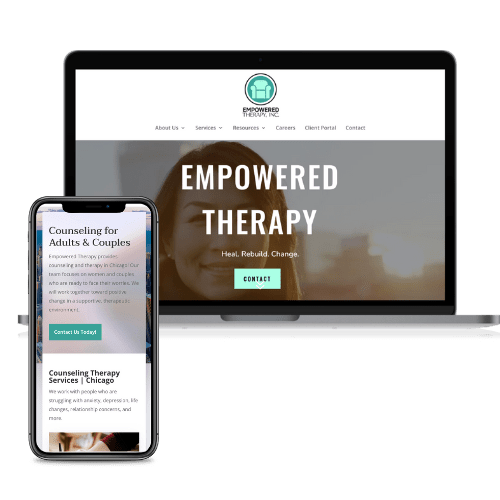
LMR helped my business grow tremendously. Lauren clearly had the knowledge of my industry and the data to support her claims.
Elizabeth Burke, LCSWCEO, Empowered Therapy
Read the full review
“I cannot recommend LMR Digital enough-when I began working with them, my business was made up of two employees. Lauren not only took the time to help me understand what her services could do for my business, but clearly had the knowledge of my industry and the data to support her claims. LMR helped my business grow tremendously, and their expertise and business acumen undoubtedly helped my business weather the COVID-19 storm. Lauren will work with you to build a sustainable and profitable business, while learning the details necessary to create authentic work for you. If you want to expand and scale your business, working with LMR Digital is the way to do it. You will see their true passion for helping you succeed paired with a nuanced understanding of data, marketing techniques, website development, and all things necessary in 2020’s business world.”
Book Your Free Consultation.
Meet with our team to talk through your practice, your services, and what growth realistically looks like for you.
Build Your SEO Strategy
Collaborate with our team to set up your marketing goals.
Ongoing SEO Support and Refinement
We monitor performance, refine strategy, and make adjustments over time so your search presence continues to support your practice as it grows.
Behavioral health SEO FAQ
Frequently asked questions
The questions practice owners ask us most about mental health SEO. If yours isn’t here, ask it on a strategy call and we’ll give you a straight answer.
Get startedStart here
Find out what SEO could bring your practice.
Tell us who you serve and where. Before we talk, we’ll look at your website, your Google Business Profile, and who outranks you for the searches that matter, so the call is about your practice, not a generic pitch.
- Send the formTakes about two minutes. Rough answers are fine.
- Pick a time that suits youA free strategy call with someone who has worked inside a mental health practice.
- Walk away with a planA sample marketing plan for your practice is yours to keep, whatever you decide.
Your details stay with us. No lists, no resale, no surprise sales calls.
Request your strategy call
Get a Comprehensive Marketing Solution for Your Mental Healthcare Practice.
1. Submit Form 2. Schedule Consultation 3. Start custom marketing solution
A few quick questions and we’ll reach out to schedule.
Loading the form…