
Built for mental health practices
SEO For Therapists
SEO for therapists is how your practice shows up when people search Google, Maps and AI tools for the help you offer. We build it for therapists, psychotherapists, psychiatrists and group practices, around your specialties and the areas you serve.
- Local SEO
- Specialty Pages
- AI Search
- Technical SEO
Treatment center or multi-location organization? See behavioral health SEO

Grow Your Practice Online
- Rank higher on Google Search
- Fill therapist caseloads with SEO
- Build content that attracts new clients
- Track results with Google Analytics
- Optimize your Google Business Profile
The short answer
What is SEO for therapists?
SEO for therapists is the practice of optimizing your website and content so your practice appears when potential clients search for help on Google. It covers local search so you show up for "therapist near me" and "counseling in Austin," keyword research, content built around the conditions you treat, and the technical health of your site. Because mental health is sensitive and competitive, it works best when the strategy is built specifically for therapists rather than borrowed from general SEO. Done well, it brings a steady stream of the right clients to your practice without paying for every click. At LMR, SEO for mental health practices is our focus, and we handle the work while explaining it in plain English.
SEO for mental health
Why SEO Matters for Mental Health Practices
- 01
Visibility
If your practice doesn’t show up when someone in your area searches for therapy services, you don’t exist to that person. SEO fixes that.
- 02
Trust
Higher rankings signal credibility. People trust the practices that show up at the top of the results.
- 03
Sustainable Growth
SEO builds long-term organic traffic. Unlike ads, it doesn’t stop working the second you stop paying.
- 04
Reaching the Right Clients
SEO helps you attract clients who are specifically looking for the services you offer, whether that’s addiction counseling, family therapy, or EMDR.
Why LMR
Experts in SEO & Marketing for Therapists & Mental Health
At LMR Digital Marketing, we specialize in SEO strategies designed specifically for therapists and mental healthcare providers. While SEO for Mental Health & Therapists is our spotlight, we offer a comprehensive digital marketing package to holistically cater to all your needs. Whether you’re looking to optimize your website for search engines, run highly targeted ads, or create engaging content, we’ve got you covered.
Our tailored approach ensures that your practice stands out from competitors and connects with the right audience—those in need of your specialized therapy services.
Increased Online Visibility
With targeted keyword research and on-page SEO strategies, your practice will rank higher on search engines, making it easier for potential clients to find you.
Content that Engages
Our team creates informative and engaging content designed to attract visitors and keep them on your website longer—boosting your site's authority in the process.
Technical SEO for Speed & Performance
We ensure your website is technically sound, fast, and secure—crucial factors for both user experience and search engine rankings.
Comprehensive Reporting
We simplify the technical details and provide easy-to-understand weekly reports, so you always know how your campaigns are performing and where improvements can be made.
SEO by provider type
SEO for Psychotherapists, Psychiatrists and Every Kind of Practice
People search differently for a psychotherapist than for a psychiatrist or a speech therapist, so the keywords, pages and Google Business Profile setup change with the kind of care you provide. Here is what we focus on for each.
Therapists and counselors
Clients search
- anxiety therapist near me
- couples counseling in Austin
One page for each specialty and each location, Google Business Profile categories that match what you do, and directory profiles that use the same practice details as your site.
Psychotherapists
Clients search
- psychotherapist near me
- EMDR psychotherapy
- psychodynamic therapy in Austin
A page for each modality you practice, explained in plain language, and bios that show your training and approach. People searching for a psychotherapist are often looking for depth and fit, not just the next open appointment.
Psychiatrists and prescribers
Patients search
- psychiatrist accepting new patients
- ADHD medication management
- telepsychiatry in Texas
Separate pages for evaluations, medication management and the conditions you treat, clear insurance and new-patient information, and prescriber bios that show credentials such as MD, DO or PMHNP. See our psychiatry marketing services.
Online and telehealth practices
Clients search
- online therapist in Texas
- virtual therapy for anxiety
Target the states you are licensed in rather than a city, with a page for each state and specialty. Google Business Profiles are meant for businesses that meet people in person, so telehealth-only practices win through their own pages, directories and content. Never use a virtual office address.
Speech therapy practices
Parents search
- speech therapist for toddlers
- late talker help
- pediatric speech therapy in Austin
Parents usually search by age and concern, so build pages around those concerns, with insurance details, what an evaluation involves, and information pediatricians need to refer.
Group practices and larger organizations
Clients search
- therapy practice near me
- trauma therapist accepting clients
Clinician bio pages that can rank on their own, location pages for every office, and specialty pages that point to the right clinicians. Running a treatment center or IOP? See behavioral health SEO.
Niche and specialty
Does a Therapist Need a Niche to Rank on Google?
Not a single niche, but you do need specialty pages. Google ranks pages, not practices, and a page that covers everything rarely ranks for anything. A therapist who treats anxiety, trauma and couples can rank for all three, as long as each one has its own page written for that client.
Therapists with a clear specialty do tend to rank faster, because every page, bio and blog post reinforces the same topic. If you are not ready to narrow your practice, narrow your pages instead. Our guide to keywords for counseling shows how to choose them.
A specialty page that ranks
- Names the concern the way clients say it
- Explains how you work with it and who it is for
- Lists your location or the states you serve
- Answers real questions in a short FAQ
- Gives one clear way to book
Free tool
Use Our SEO Analysis Tool!
Not sure if your SEO copy is working hard enough? Enter the details below and we'll tell you exactly what's working — and what needs fixing.
- Checks your title and meta description length
- Looks for your keyword where Google expects it
- Flags missing calls to action
What phrase do you want to show up for in Google? (e.g. "couples counseling Chicago")
This is the blue clickable headline that shows up in Google search results. It's specifically written for search engines and should be 50–60 characters. No idea what this is? Schedule a consultation with an SEO expert.
This is the 2–3 sentence snippet that appears under your title in Google. It doesn't directly affect ranking, but it hugely affects whether someone clicks. Aim for 120–155 characters. No idea what this is? Schedule a consultation with an SEO expert.
Search + AI
AI SEO for Therapists: Showing Up in ChatGPT and AI Overviews
AI-powered tools like ChatGPT, Google's AI Overviews, and voice assistants are reshaping how potential clients find therapists online. People are asking full questions now, not just typing keywords. They're saying things like "who is the best therapist for anxiety near me" or "what should I look for in a couples counselor." If your content isn't structured to answer those kinds of questions directly, you're losing visibility in the places where search is headed. We optimize your content so it shows up in traditional search results and in the AI-driven answers that are quickly becoming the first thing people see.
How to show up in AI search
- Answer real questions. Use the questions clients ask as headings and answer each in the first sentence or two.
- Make your practice easy to identify. Keep your name, address, credentials and specialties identical on your site, Google Business Profile and directories.
- Show who is behind the content. Clinician bios and bylines with licenses help AI tools judge whether to trust a page.
- Add structured data. FAQ, LocalBusiness and Person schema help machines read what your pages are about.
- Earn mentions on trusted sites. AI answers lean heavily on what directories, local news and associations say about you.
No one can guarantee a citation in an AI answer, but these steps make your practice easier to find and trust.
Step by step
How to Build SEO for Your Therapy Practice, Step by Step
- 1
Set up your Google Business Profile
Claim it, choose accurate categories, list every service, add real photos and a booking link. It is the foundation of local SEO and the fastest way into the map results.
- 2
Research your keywords
Find the words clients actually type, pairing your specialties with your city or state. We work the right keywords into page titles, meta descriptions, headings and content.
- 3
Fix the technical basics
A fast, mobile-friendly, secure site with a clean structure. Check Search Console for pages Google has not indexed. If the backend is not right, even great content will not perform.
- 4
Build specialty and location pages
One page for each specialty and each place you serve, each written for that client. This is where most practices see the biggest jump. See how it works.
- 5
Make it easy to reach out
Clear navigation, real clinician bios and one obvious way to book on every page. A site people can use keeps them longer and tells Google it is worth showing.
- 6
Publish helpful content and keep going
Blogs that answer the questions clients ask you, shared on social media to bring people back. Social does not move rankings directly, but it builds recognition. Read blogging for therapists.
Not sure which step to tackle first? Read the best SEO strategy for a therapy practice or check your site for SEO warning signs.
Effective SEO strategies
Location and Specialty Pages
Location pages and specialty pages are two of the most effective ways to rank for specific keywords in the mental health space. A location page targets a geographic area you serve, like “mental health counseling in Austin” or “therapy services in Brooklyn.” A specialty page targets a specific service, like “PTSD treatment,” “adolescent therapy,” or “medication management.”
Without these pages, your site is relying on your homepage to do all the heavy lifting. And your homepage can only rank for so many terms.
Dedicated pages give Google clear signals about what you offer and where you offer it, which means you show up in more searches for more specific terms.
The key is making sure each page has unique, quality content. Google can tell when location pages are just the same copy with a different city name swapped in. Every page needs to feel like it was written for that specific audience in that specific area. The same goes for specialty pages. A page about anxiety therapy should speak directly to someone searching for help with anxiety, not just list it as one of ten services in a sidebar.
We build out location and specialty pages strategically based on the keywords with real search volume so your practice shows up for the exact things people are looking for, in the exact places they’re looking.
Location pages
- Mental health counseling in Austin
- Therapy services in Brooklyn
Specialty pages
- PTSD treatment
- Adolescent therapy
- Medication management
One page trying to rank for everything.Each page gives Google a clear signal for one search.
LOCAL SEO
Show Up Where Your Clients Are Searching
Local SEO is what gets your therapy practice in front of people searching in your area. When someone types "therapist near me" or "anxiety counseling in Austin," Google decides which practices to show based on how well your online presence is optimized for local search. But here's what a lot of people don't realize — even when someone searches by city name, their physical location at the time of the search impacts what Google shows them.
Two people searching the exact same thing from different zip codes can get completely different results.
Getting local SEO right starts with a fully optimized Google Business Profile, dedicated location pages on your site, and consistent NAP (name, address, phone number) information across every platform your practice is listed on.
Measuring local SEO is trickier than standard SEO because tools like Ahrefs and SEMrush can't always capture what people are actually seeing in their local results. The data is too location-dependent. To get a real picture of how your local SEO is performing, you have to look at your actual data. Proper tracking setup helps, and Google Search Console is one of the best tools for understanding which local queries are bringing people to your site.
KEYWORD STRATEGY
Find the Right Words. Put Them in the Right Places.
Keyword research is the foundation of everything we do with SEO. It's how we figure out exactly what potential clients are typing into Google when they're looking for a therapist. Some are searching broad terms like "therapy near me." Others are getting specific, things like "EMDR therapy for trauma in Austin" or "therapist who takes Blue Cross." If your site doesn't include those terms, you're invisible to those people.
Once we identify the right keywords, we work them into the places that matter most. Page titles, meta descriptions, headers, and naturally throughout your content. The goal isn't to stuff keywords everywhere. It's to make sure your site speaks the same language your potential clients are already using so that when they search, Google knows your site is the answer.
Our toolkit
The Tools Behind the SEO Strategy
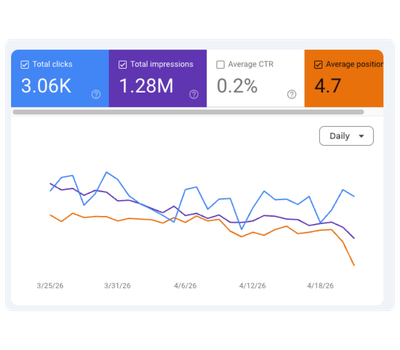
Google Search Console
This is where you see how Google actually views your site. Search Console shows you which pages are indexed, what keywords are driving traffic, and flags technical issues that could be holding your rankings back.
Google Analytics
Analytics tells you who's visiting your site, where they're coming from, and what they're doing once they get there. It's the clearest picture you'll get of what's working and where people are dropping off.
Google Keyword Planner
Keyword Planner helps you find the exact terms potential clients are searching for and how competitive those terms are. It's one of the best tools for making sure your content is targeting the right searches.
Together these cover the numbers worth checking every month: clicks and impressions in Search Console, calls, direction requests and website clicks from your Google Business Profile, and inquiries that came from organic search. Want a quick check first? Try our free SEO title and meta checker or request a mini SEO audit.
Trust and E-E-A-T
The Trust Signals Google Looks for in Mental Health SEO
Google treats mental health content as “Your Money or Your Life” and holds it to a higher standard of experience, expertise, authoritativeness and trust, often shortened to E-E-A-T. Professional ethics codes add rules of their own. Good SEO for therapists is built to meet both.
Credentials on every page
Bylines or “reviewed by” lines with license type and state, clinician bios that show training and experience, and an About page that makes clear who runs the practice.
Careful, accurate content
Educational wording such as “many people with anxiety notice…” rather than diagnosing the reader, no promised outcomes, reputable sources where you cite facts, and visible dates when you update a page.
Reviews that follow the rules
The APA, ACA and NASW codes say not to solicit testimonials from current clients. Make your review link easy to find, and reply without confirming that anyone is a client. More in our mental health marketing ethics guide.
Privacy built in
A secure site, no clinical details in contact forms, and ad or analytics tags kept off booking, intake and patient portal pages so health information never reaches third parties.
Authority from outside your site
Mentions and links from professional associations, local organizations, podcasts and press. Offering expert commentary to journalists is one of the most reliable ways for therapists to earn them.
The same details everywhere
Practice name, address, phone, credentials and specialties that match across your site, Google Business Profile, Psychology Today and insurance directories. Search engines and AI tools both rely on that consistency.
This is general guidance, not legal advice. Your licensing board and state rules can be stricter.
Mental health SEO timeline
SEO for Mental Health is a Long Game
SEO is not a quick fix. It’s a 6 to 12 month commitment that builds over time. Consistency in content, technical updates, and ongoing optimization is what separates practices that grow from practices that stay stuck on page two. We’re in it for the long haul with every practice we work with.
- Months 1–3
Foundations
Technical fixes, keyword plan, Google Business Profile and your most important pages.
- Months 3–6
Momentum
New location, specialty and blog content starts earning rankings and clicks.
- Months 6–12
Compounding
Steady organic inquiries that keep coming without paying for every click.
SEO for Therapists, Built Only for Mental Healthcare Providers
LMR Digital Marketing provides marketing including SEO for Therapists exclusively for mental and behavioral healthcare professionals, including psychiatrists. We bring patient leads to you efficiently and consistently through a blend of SEO and targeted advertising campaigns.
By focusing on your unique selling points and understanding the nuances of your practice, we ensure your digital strategy is as impactful as possible.
Running a treatment center, IOP or PHP program, or a multi-location organization? See how we approach behavioral health SEO for larger organizations.
Schedule a consult
The process
How Do We Do It?
Smart strategy backed by real data and years of experience working with therapists and mental health practices. We handle the SEO, explain everything in plain English through weekly reporting, and keep a steady stream of the right clients coming to your practice.
Request a strategy call- 1
Book Your Free Consultation
Meet with our team, walk us through your practice and goals, and we'll tell you exactly how we can help.
- 2
Build Your SEO Strategy
We work with you to build an SEO plan tailored to your practice, your specialties, and the areas you serve.
- 3
Watch Your Rankings Grow
We handle the work, keep you updated, and deliver clear reporting that shows you exactly what's moving.
FAQ
Common Questions About SEO for Therapists
Running a larger organization? Our behavioral health SEO page covers treatment centers and multi-location groups.
Ask a questionOur why
We Love Doing SEO For Therapists
At LMR, our passion for mental health shows up in every piece of work we produce. We create SEO strategies that do more than drive traffic. They connect real people with the therapists and mental health services that can actually help them. We work with practices that share our dedication to the well-being of others, and we take pride in knowing that when our SEO works, the right clients find the right providers. We are grateful to do work every day that makes a real difference in people's lives.










Start here
Find out what SEO could bring your therapy practice.
Tell us what you treat and where you see clients. Before we talk, we’ll look at your website, your Google Business Profile and the practices outranking you, so the call is about your caseload, not a generic pitch.
- Send the formTakes about two minutes. Rough answers are fine.
- Pick a time that suits youA free strategy call with someone who has worked inside a mental health practice.
- Walk away with a planA sample marketing plan for your practice is yours to keep, whatever you decide.
Your details stay with us. No lists, no resale, no surprise sales calls.
Request your strategy call
Get a Comprehensive Marketing Solution for Your Mental Healthcare Practice.
1. Submit Form 2. Schedule Consultation 3. Start custom marketing solution
A few quick questions and we’ll reach out to schedule.
Loading the form…
Client Showcase
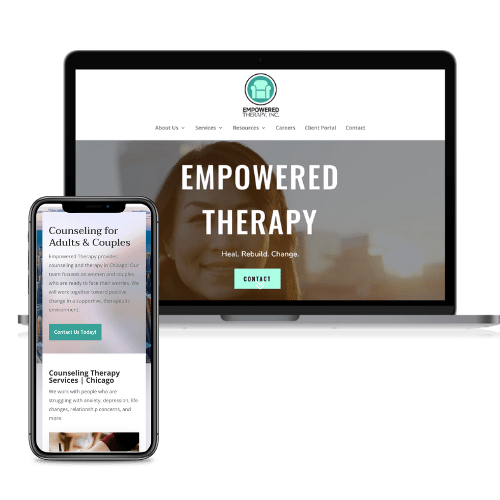
"I cannot recommend LMR Digital enough-when I began working with them, my business was made up of two employees. Lauren not only took the time to help me understand what her services could do for my business, but clearly had the knowledge of my industry and the data to support her claims. LMR helped my business grow tremendously. They will work with you to build a sustainable and profitable business, while learning the details necessary to create authentic work for you. If you want to expand and scale your business, working with LMR Digital is the way to do it. You will see their true passion for helping you succeed paired with a nuanced understanding of data, marketing techniques, website development, and all things necessary in a modern digital business world."
Elizabeth Burke, LCSWCEO, Empowered Therapy
See the strategy and numbers behind our work in our case studies.